
By 9 PM I am usually at my desk for the third time that day. I finish a twelve-hour shift, eat something, help my kids with whatever they need, and then sit down to chart. The overhead light in my spare room is one of those flat LED panels that was supposed to be energy-efficient and ended up feeling like a interrogation lamp. After six months of evening sessions under it, I was getting to bed with a dull throb behind my eyes every single night.
The Quntis Computer Monitor Light Bar, ASIN B08DKQ3JG1, has been clipped to the top of my 24-inch monitor for just over a year now. I paid today's price and I use it seven nights a week, minimum two hours each session. This is not a quick-impression review. This is twelve months of real charting work under it.
The Quick Verdict
A well-designed budget monitor lamp that genuinely reduces eye strain during evening screen sessions, with a wide color temperature range and solid auto-dimming, held back only by thin-bezel clamp fit issues and a learning-curve touch strip.
Amazon Check Today's Price →Tired eyes by 9 PM? This affordable lamp is probably the fastest fix on your desk.
The Quntis monitor light bar sits on top of your monitor, lights your desk without hitting your eyes, and plugs into any USB port. No installation, no tools. Most people notice a difference the first night.
Amazon Check Today's Price on Amazon →How I Have Used It Over the Past Year
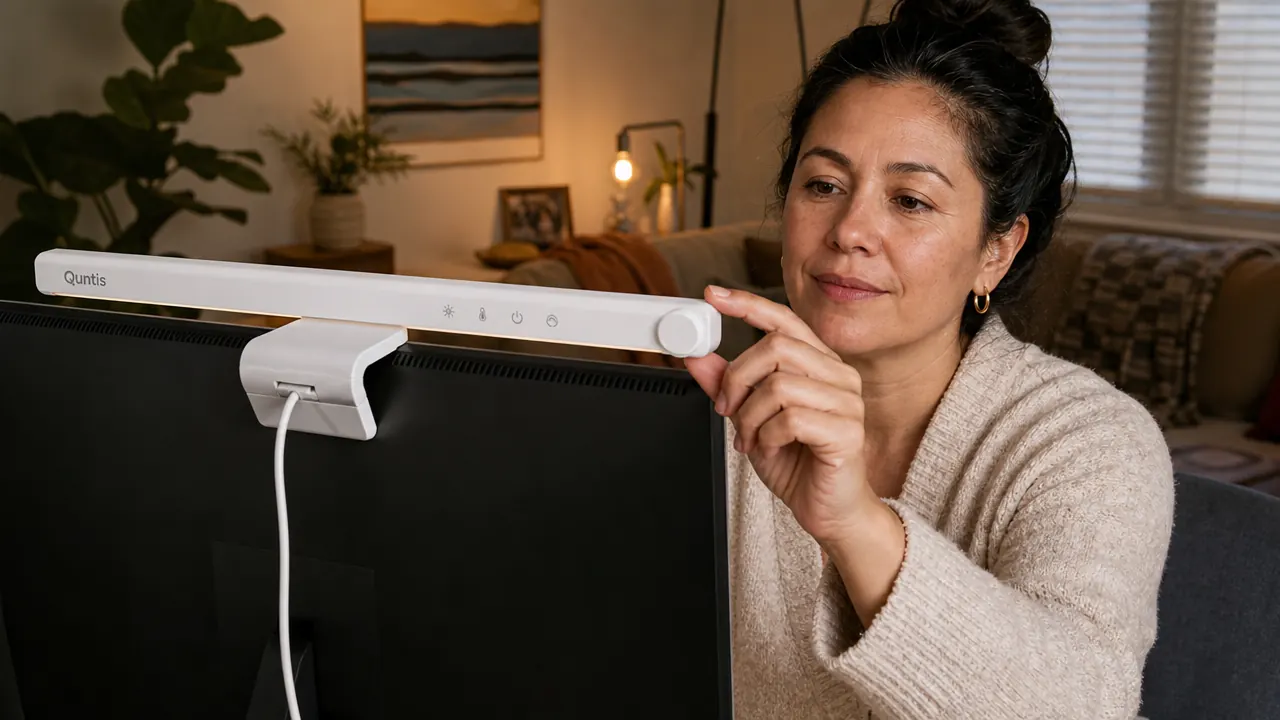
My setup is a 24-inch 1080p monitor on a VIVO arm, pushed back about 24 inches from where I sit. The Quntis clamp slid onto the top bezel without any tools. It took four minutes start to finish, including routing the USB cable down the back of the monitor to the USB port on my PC. The magnetic weight distribution means the lamp does not tip forward or backward once you seat it, even if you bump the monitor to adjust the arm.
My standard workflow: I open my charting software, tap the light bar to power it on, twist the right-side rotary knob to warm white around 2700K, and dial brightness down to about 60 percent. That setting puts a clean, shadow-free pool of light on my keyboard and the paper notes I keep beside the keyboard, without bouncing light off the monitor glass. I have maybe adjusted the position of the lamp itself three times in a year. Once you find the angle, you leave it.
For daytime use, I slide the color temperature toward the cooler end, around 5000K, and crank the brightness to about 80 percent. The transition between the two extremes is smooth, not steppy, which matters because the transition happens in a fully lit room where your eyes are already adapted and any abrupt jump is noticeable.
Light Quality: What the Specs Actually Mean in Practice
The Quntis puts out a range of 2700K to 6500K color temperature, which covers everything from a warm incandescent feel to a crisp cool-daylight mode. For evening screen work, warm white is the correct setting. Blue-rich light from cool lamps at night suppresses melatonin and makes it harder to wind down after you close the laptop. When I started using the warm setting intentionally instead of just picking whatever felt bright, I noticed I was less wired when I got into bed around midnight.
The asymmetric lens design is the key differentiator over a regular desk lamp. A standard lamp throws light in a cone that inevitably hits the monitor glass at some angle and creates a reflection you have to shift in your chair to avoid. The Quntis directs light downward and slightly forward onto the desk surface only. In a year of use I have never seen my own lamp reflection in the monitor, and that includes night sessions where the room behind me is completely dark and reflections are at their worst.
Color rendering index (CRI) is rated at 90-plus, meaning colors look accurate under it rather than washed or shifted. For nursing documentation this matters less than for someone doing photo editing, but when I am reading printed labs or medication sheets on my desk, the text reads the same under the Quntis as under natural daylight. There is no green cast or skin-tone weirdness you get from bargain LED strips.
In twelve months of evening charting sessions I have not once gone to bed with that specific behind-the-eyes ache that I used to treat as just part of the job. That is the only metric that matters to me.
Auto-Dimming: Does It Actually Work?
The lamp has an ambient light sensor built into the top of the housing. When auto-dimming is enabled, it reads the room light level and adjusts the lamp brightness accordingly. In theory, this means you never have to touch the lamp when a cloud passes or when someone switches a hallway light on. In practice, the sensor is calibrated conservatively, meaning it adjusts in gentle steps rather than snapping between brightness levels. Over a long session where the ambient light is slowly fading as the evening deepens, it works seamlessly. I have never noticed it actually adjusting in real time, which I mean as a compliment.
Where it gets fussy: if someone walks through the room behind you carrying a phone with the flashlight on, the lamp briefly bumps brightness and then walks it back down. It is not disruptive but it is noticeable once you know to look for it. For most working environments, this will never come up. In a busy house, it comes up occasionally.
The Controls: Touch Strip Learning Curve
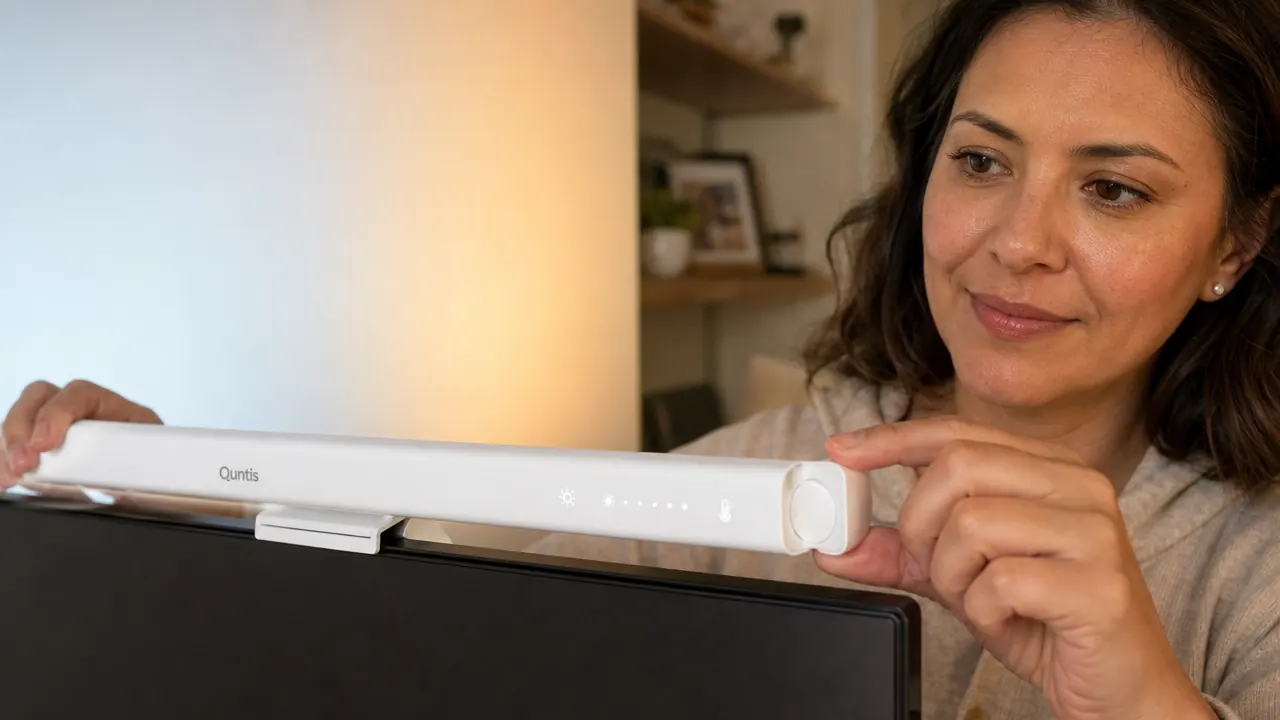
There are two ways to adjust the Quntis: a touch-sensitive strip on the top of the housing for power and brightness steps, and a physical rotary knob on the right end for color temperature. After a year, I have a strong preference: use the knob for everything and mostly ignore the touch strip.
The touch strip is accurate enough but it requires a deliberate flat-finger tap rather than a casual poke. If you are used to capacitive touch surfaces on phones, your first dozen interactions will accidentally do nothing or double-tap. The rotary knob, on the other hand, is satisfying and precise. A quarter turn shifts color temperature noticeably. A full rotation covers the entire range. I cannot think of a situation where I would rather use the touch strip over the knob for color temperature adjustment.
Power on and off via the touch strip works reliably after you learn the right touch pressure. If you are buying this for a family member who is not patient with gadgets, walk them through the tap pressure once. After that, it is not an issue.

Clamp Fit: The One Thing to Check Before You Order
The Quntis uses a weighted magnetic clamp that rests on the top bezel of your monitor. On monitors with a bezel thickness of roughly 8 to 15 millimeters, it sits flat and stays put. On very thin-bezel monitors under 6mm, the lamp can rock forward slightly. My 24-inch has a standard bezel and fit is perfect. But I tried it on my partner's newer ultrawide with a nearly frameless design and the lamp tilted about 10 degrees before I caught it. Quntis sells a pro version with an adjustable clamp pad that handles thin bezels better. If your monitor is less than two years old and has a near-borderless design, look up your bezel thickness before you order the standard version.
On curved monitors the story is similar. The magnetic base compensates for gentle curves, and up to about 1500R curvature the lamp sits level. Sharper curves will cause a noticeable tilt. Again, check the spec before ordering.
How It Compares to What Else I Considered
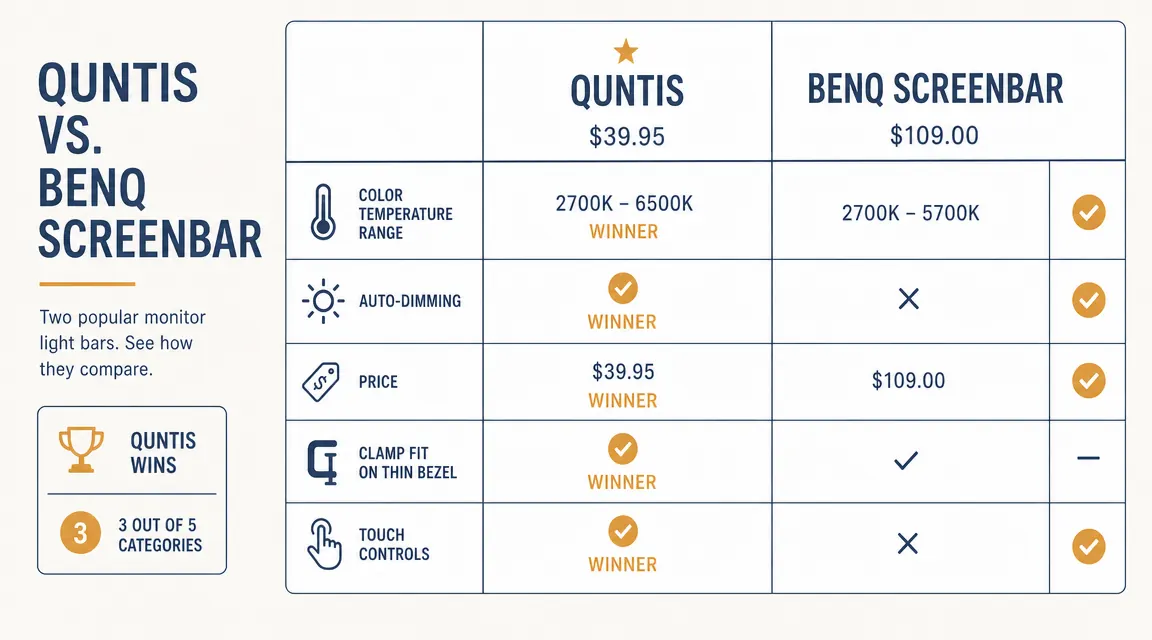
Before the Quntis I was using a basic gooseneck LED desk lamp aimed at the wall to bounce diffused light. It cut the glare problem somewhat but the bounce light was not bright enough for reading printed notes without leaning forward. I also looked hard at the BenQ ScreenBar, which is the obvious comparison. The BenQ is a better-built product with a more refined touch bar and a slightly wider light spread. It is also three times the price at the premium tier. For evening charting on a modest salary, that gap is not justifiable when the Quntis solves the same core problem at the budget tier.
The one area where the BenQ genuinely pulls ahead is the touch control interface, which is more intuitive and reliable. If you are buying a monitor lamp as a gift for someone who will not tolerate any learning curve, the BenQ is worth the premium. For your own desk, where you will use it thirty times before the touch strip becomes second nature, the Quntis wins on value by a wide margin.
What I Liked
- Asymmetric lens keeps all light off the monitor glass, zero reflection even in a dark room
- 2700K to 6500K color range covers warm evening work and cool daytime focus modes
- Auto-dimming sensor works invisibly during normal sessions, no manual babysitting
- Magnetic clamp installs in under five minutes, no tools, no bezel damage after a year
- USB powered from any port on the monitor itself, no wall adapter needed
- CRI 90-plus means paperwork reads accurately under it without color shift
Where It Falls Short
- Touch strip requires deliberate flat-finger pressure, not intuitive for first-time users
- Standard clamp is not rated for very thin bezels under about 6mm
- Auto-dimming is slightly sensitive to sudden room light changes from people moving around
- No memory for last brightness and color temperature setting after power cycle
Who This Is For
This lamp was designed for people who work evening or night sessions in front of a screen and have already tried turning down monitor brightness without fixing the eye strain problem. The issue is not usually the screen itself. It is the contrast ratio between a lit screen and an unlit desk surface, and the reflections that bounce off the monitor from a ceiling lamp positioned behind you. The Quntis fixes both of those things for about the price of two months of a streaming service subscription. It is also the right choice for anyone who has been using a standard desk lamp and keeps catching the lamp reflection in the corner of their monitor.
Budget-conscious buyers are the obvious core audience. Remote workers who spend two or more hours per evening at a screen, people who do online schoolwork after dark, nurses and other medical professionals doing home charting, anyone whose desk sits in a bedroom where ceiling lights are either off or aimed away from the workspace. If your monitor has a standard bezel and you plug your laptop in to a USB-A or USB-C hub, this lamp will work and you will likely stop thinking about lighting as a problem within the first week.
Who Should Skip It
If you have a new thin-bezel or curved monitor under 1500R and you do not want to check specs before ordering, skip the standard version and look at the Quntis Pro or the BenQ ScreenBar, which both have clamp systems designed for frameless displays. If your primary concern is gifting this to someone who will not want any learning curve with controls, the BenQ ScreenBar's touch interface is more forgiving and worth the price difference for that specific use case. And if you are a video editor, photographer, or graphic designer who needs a lab-grade CRI of 95-plus for color-accurate work, this is a home-office lamp, not a professional studio light. It will not replace a dedicated task light for color-critical applications.
For everyone else, especially anyone who feels like eye fatigue is just a built-in cost of evening screen work, spend the modest amount and see what your eyes feel like after two weeks. I was skeptical that a lamp could make a real difference. I was wrong.
A year of nightly use and I would buy it again without hesitating.
The Quntis monitor light bar is available on Amazon and ships Prime. It takes four minutes to set up and the USB cable hides behind your monitor. If you are charting, studying, or working evenings and your eyes hurt by the end of the session, this is the desk upgrade to try first.
Amazon Check Today's Price on Amazon →